Know the ins and outs of construction loans: Are they right for your project?
Facing the prospect of financing a home construction or renovation can often feel like standing at the base of a towering skyscraper, wondering how to reach the top. Construction loans are the scaffolding that helps you climb, step by step, towards your dream home. But are they the right tools for your project?
In this blog, we simplify the concept of construction loans. These specialised loans are essential for those planning to build or renovate a home, offering financial support that aligns with your project's progress.
We'll explain how they function, guide you through obtaining one, and share strategies for effective management. Understanding construction loans is key to embarking on a new build or transforming an existing property. Let's explore if construction loans can be the solid foundation for your dream home project.
Key takeaways
- Construction loans are specifically designed for building or renovating homes.
- Interest on a construction loan is only paid on the amount drawn down during construction.
- Pre-approval and financial scrutiny are key steps in securing a construction loan.
- Strategies for securing low-interest rates include good credit and shopping around.
- Understanding fixed vs. variable rates is important in loan selection.
What are construction loans?
Construction loans are specialised financial products tailored for financing the building of a new home or undertaking significant renovations. Unlike standard home loans, which are typically disbursed as a lump sum, construction loans are designed to fund the building process in stages, aligning with the needs of a construction project.
The primary purpose of these loans is to provide financial flexibility during the construction phase. Borrowers benefit from this type of loan as it allows them to manage cash flow more effectively. Instead of bearing the full interest cost of the entire loan amount from the start, they only pay interest on the amount drawn down at each stage of construction.
How do construction loans work?
The process of construction loans involves progressive drawdowns or progress payments. This means the loan amount is not disbursed in one go but in stages as the construction progresses. Each stage of construction is typically associated with a milestone in the building process, such as laying the foundation, framing, lock-up, and completion.
For instance, once the foundation of the house is laid, the builder will issue an invoice for this stage. The homeowner then presents this invoice to the lender, who releases the funds to cover the cost. This process continues throughout the construction phase, with the lender disbursing funds at each stage upon receiving and approving the corresponding invoice.
During construction, borrowers usually pay interest only on the amount drawn down. This arrangement helps lower initial repayments, as the full loan amount is not utilised immediately. Once construction is completed, the loan typically reverts to a standard principal and interest loan unless otherwise structured.
This method of financing is advantageous as it ensures that funds are available when needed and borrowers do not pay interest on the full loan amount before it is fully utilised. It also provides a mechanism for the lender to monitor the progress of the construction, ensuring that funds are used appropriately and the project is progressing as planned.
Steps to secure a construction loan
Securing a construction loan is critical in financing your dream home-building project. Unlike standard home loans, construction loans cater specifically to the needs of building a new home or undertaking significant renovations. Here’s a step-by-step guide to navigating this process:
Pre-approval process:
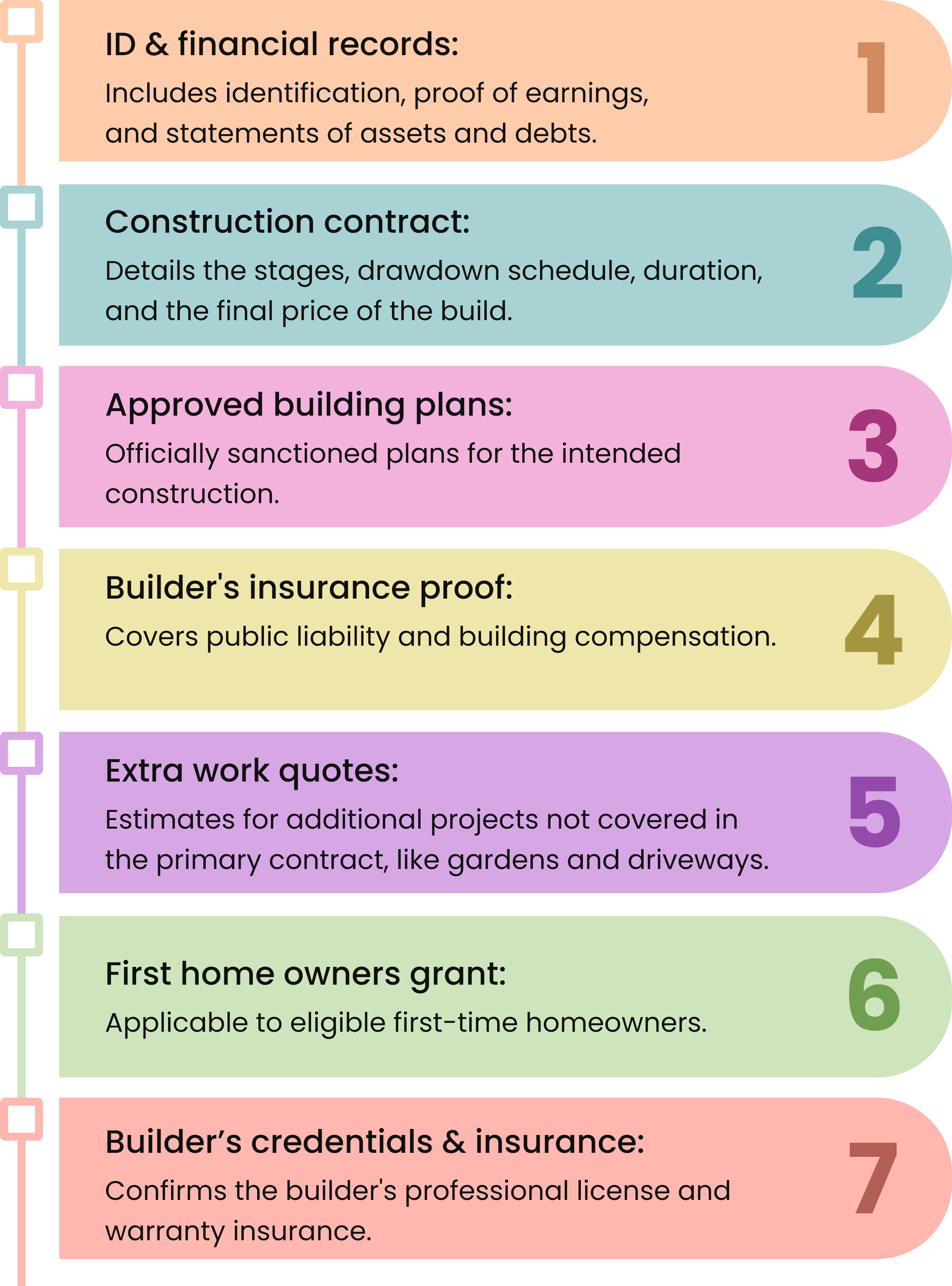
The journey to securing a construction loan begins with the pre-approval process. This step involves gathering and submitting crucial documents to your lender. You'll need to provide evidence of your financial situation, including documentation of your income flow and any outstanding debts. A detailed building contract is also required, outlining the construction stages and a drawdown schedule.
This schedule is essential as construction loans do not pay a lump sum but release funds progressively as the building work advances. You must also submit an estimated build time and a copy of the building plans. Once the lender has all the necessary documents, they will assess your situation and extend a pre-approval for a specific loan amount. This pre-approval typically remains valid for 90 days.
The pre-approval document List
Financial scrutiny:
Lenders thoroughly assess your financial health before granting a construction loan. This scrutiny involves examining your credit score, income, and expenses to determine your borrowing capacity and reliability as a borrower. The lender aims to ensure you can comfortably manage the loan repayments alongside your other financial obligations. This step is crucial as it influences the loan amount and terms you will be offered.
Property valuation:
Property valuation is pivotal in the construction loan process. Before finalising the loan amount, lenders require a property valuation to ensure the loan amount aligns with the property's market value. This valuation is particularly important in construction loans as the final value of the property upon completion of construction can significantly impact the loan terms.
Hiring contractors and communicating with the lender:
After securing pre-approval, the next step is hiring a builder and purchasing materials. It's advisable to include a clause in your contract to cover any unexpected costs that may arise during construction. Unlike regular home loans, construction loans are paid out in increments, aligning with completing different construction stages.
Therefore, maintaining open communication with your lender is essential. You and your builder must provide regular progress updates and adhere to the payment schedule. Lenders often require inspections at each construction stage to ensure the funds are utilised appropriately.
Finalising the loan and construction completion:
Once your home is completed, the construction loan will convert to a standard home loan, typically a low-rate variable loan. Upon construction completion, the final loan amount is based on the property's value. Throughout this process, it's crucial to work closely with your lender to ensure all requirements are met, and the transition from a construction loan to a standard home loan is smooth.
Strategies for securing low-interest rates on construction loans
Credit score and financial health:
A strong credit score and stable financial history are crucial in securing low-interest rates for construction loans. Lenders meticulously assess your credit score, income, expenses, and other debts to ensure you can comfortably service the loan.
A higher credit score typically indicates a lower risk to lenders, potentially leading to more favourable loan terms and lower interest rates. Maintaining a healthy financial profile, including a stable income and a low debt-to-income ratio, can significantly enhance your loan eligibility and the likelihood of a lower interest rate.
Find out how much you can borrow for your construction project with our borrowing power calculator.
Shopping around for lenders:
It's essential to compare different lenders and loan offers when seeking a construction loan. Each lender has unique loan products, interest rates, and terms. You can find the most competitive rates and terms that suit your needs by shopping around. Consider various financial institutions, including banks, credit unions, and online lenders, to view the available options comprehensively. At ZedPlus, we offer a comprehensive range of options from over 40 lenders, ensuring you find the perfect match for your project's needs.
Negotiation tips:
Negotiating terms with lenders can lead to more favourable loan conditions. Prepare to discuss various aspects of the loan, such as the interest rate, loan term, and any associated fees. Demonstrating a strong financial position and knowledge of the market can give you an edge in negotiations. Don't hesitate to ask for better terms or clarification on loan aspects. Remember, lenders are often willing to negotiate to secure your business.
Fixed vs. variable rates:
Understanding the pros and cons of fixed and variable interest rates is vital in construction loans. Fixed-rate loans offer stability, as the interest rate remains constant throughout the loan term, making budgeting easier. However, they might come with higher initial rates compared to variable-rate loans.
On the other hand, variable-rate loans can offer lower initial rates. Still, the interest rate can fluctuate over time based on market conditions, potentially leading to higher costs in the long run. Consider your financial situation, risk tolerance, and market trends when choosing fixed and variable rates.
Understanding the payment structure of construction loans

Construction loans typically involve a payment structure aligned with the various stages of construction. These stages include:
Interest-only period:
During construction, interest is typically calculated only on the drawn amount. You only pay interest on the loan portion disbursed to the builder at each stage. For instance, if you've drawn $100,000 on a $300,000 loan, interest will be charged only on the $100,000.
This structure helps manage the financial burden during construction, as you're not paying interest on the entire loan amount upfront. Once construction is complete, the loan usually converts to a standard principal and interest loan, marking the start of the contract term.
Risks and considerations in construction loans
Market fluctuations:
Market fluctuations can significantly impact construction loans, particularly interest rates. Since construction loans often have variable rates, changes in the market can lead to fluctuations in these rates. This can affect the overall cost of the loan, making budgeting for the project more challenging. For instance, if market interest rates rise during the construction period, the interest component of the loan will increase, leading to higher overall costs.
Budget overruns:
Budget overruns are a common risk in construction projects. They can occur due to unforeseen circumstances, changes in material costs, or modifications to the original plan. These overruns can impact the loan amount and interest, as additional funds may be required to complete the project. This can lead to a higher loan principal, which in turn increases the interest payments. Borrowers must have a contingency plan and budget to manage these potential overruns.
Conclusion
Construction loans are a specialised financial tool essential for bringing your dream home to fruition. They offer flexibility and financial prudence, aligning with the unique demands of building or renovating a home. While they present an advantageous path, they also require a deep understanding of their structure, market conditions, and prudent financial planning to navigate potential risks and budget overruns.
This is where ZedPlus steps in as your trusted partner. With our access to over 40 lenders, we offer a wide range of construction loan options tailored to suit your specific project and financial circumstances. Our expert team provides personalised assessments, meticulously understanding your financial situation to determine your optimal borrowing capacity.
Our commitment includes maintaining clear and consistent communication throughout the loan process, guiding you with transparency and expertise every step of the way. At ZedPlus, our experts are committed to simplifying the complexities of construction loans, making your journey towards building your dream home a smooth and supported experience. Discover how we can assist you by reaching out to us now.