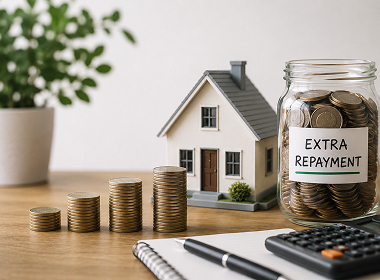

Should I make extra payments to my mortgage?
If you have got a bit of spare cash sitting in your bank account each month, you have probably wondered whether it should go towards your mortgage. It's one of the most common questions Australian homeowners ask.
The short answer is that making extra repayments is one of the most effective ways to cut your interest costs and become debt-free sooner. But depending on your lender and your loan's conditions, going beyond your required monthly repayments can come with both upsides and downsides.
In this blog post, we will walk through exactly how extra mortgage repayments work, the real dollar impact they can have over the life of your loan, when they make sense (and when they don't), and how to use an extra payment mortgage calculator to run the numbers for your own situation.
Key takeaways
- Extra mortgage repayments reduce your loan principal faster, helping you save on interest.
- Even small additional repayments can save thousands of dollars over the life of your loan.
- Always check your loan terms before making additional repayments.
- Fixed-rate home loans may limit how much extra you can repay each year.
- Keep an emergency fund before committing all spare cash to your mortgage.
- Regular additional repayments create long-term savings through compounding interest reductions.
- Professional advice can help you choose the best repayment strategy.
How do extra mortgage repayments work?
When you take out a home loan, your regular repayments are calculated to cover both the principal and interest over an agreed term, typically 25 or 30 years. Each repayment you make is split between interest charges and a reduction of your loan balance.
In the early years of a mortgage, a larger share of each repayment goes towards interest rather than principal. This is simply because interest is calculated on your outstanding balance, and that balance is at its highest right at the start of the loan.
When you make an extra payment, that amount goes straight towards reducing your principal, rather than being split like your regular repayment (assuming your loan has no restrictions on additional repayments).
Since most Australian home loans calculate interest daily, a lower principal balance means less interest builds up from that point onward. This creates a compounding effect over time, as less interest means more of your future repayments go towards principal, which reduces interest even further, and so on.
Extra payments to the mortgage example
Say you have a $600,000 home loan at 6.00% interest over a 30-year term. Your standard monthly repayment would be $3,597, and over the full 30 years, you would pay approximately $695,000 in interest on top of the amount you borrowed.
If you add an extra $300 a month, bringing your repayment to $3,897:
- Time saved: You would pay off your loan in around 24 years and 6 months (roughly 5 years and 6 months earlier than the original term).
- Interest saved: You would pay approximately $547,700 in interest, saving about $147,000 compared to sticking with the minimum repayment.
Wondering how this applies to your mortgage? Our extra payment mortgage loan calculator lets you test a range of extra repayment amounts and see the impact on your loan term and interest costs instantly.
Benefits of making extra mortgage repayments
Here are just some of the key advantages of making extra repayments:
You pay significantly less interest
This is the biggest advantage by far. Every extra dollar paid off your principal early stops that dollar from accruing interest for the remaining life of the loan. Over a 25 to 30-year mortgage, this can mean the difference between paying off your home and paying tens or even hundreds of thousands of dollars in interest.
You shorten your loan term
Every extra payment brings your mortgage-free date closer. For a lot of Australians, being debt-free years earlier isn't just a financial win; it is a lifestyle goal, whether that means retiring without a mortgage, freeing up income for other investments, or simply having one less financial commitment to worry about.
You build equity faster
Paying down your principal faster means you build equity in your property more quickly than you would by sticking to minimum repayments alone. This can put you in a stronger position if you plan to unlock your home equity later on, whether that's for a renovation, purchasing an investment property, or supporting your borrowing power for other financial goals.
You reduce risk if rates rise again
Extra repayments can act as a buffer against future interest rate increases. Since your outstanding loan balance is lower than it would otherwise be, any future rate rise has a smaller dollar impact on your repayments compared to if you'd only ever paid the minimum.
And if your home loan offers a flexible redraw facility option, those extra repayments aren't necessarily locked away either; you can withdraw them down the line if needed, giving you a safety net for unexpected financial difficulties.
Quick fact
After three rate cuts in 2025, the RBA lifted the cash rate three times again in early 2026, bringing it back up to 4.35%. It's a reminder that rates can go up as easily as down, and a lower loan balance from extra repayments can lessen the impact whenever the next rise comes.
When should you avoid making extra mortgage repayments?
While extra repayments offer clear benefits, they are not automatically the best option for every household. Here are some scenarios where it is worth pausing to think it through.
You are on a fixed-rate loan
Many fixed-rate home loans in Australia limit how much extra you can repay each year, often capped at $10,000 to $30,000 depending on the lender, before break costs or fees apply. Exceeding this cap can trigger significant break fees. If you are on a fixed rate, check your loan contract or speak with your broker before increasing your repayments.
You have higher-interest debt elsewhere
If you are carrying credit card debt, a personal loan, or a vehicle loan with a higher interest rate than your mortgage, it usually makes more financial sense to pay down that debt first. Mortgage rates are typically among the lowest forms of consumer debt, so prioritising higher-interest debts first will usually save you more money overall.
You do not have an emergency fund
Financial experts generally recommend having three to six months of living expenses set aside before aggressively paying down debt. If an emergency arises and your extra repayments are not easily accessible (for example, if your loan does not have a redraw facility), you could find yourself in a difficult cash flow position.
You are not contributing to superannuation or other long-term investments
Depending on your age, tax situation, and financial goals, there may be scenarios where additional superannuation contributions or other investments offer a better long-term return than extra mortgage repayments, particularly given the tax concessions available on super contributions. This is a decision that often benefits from professional financial advice tailored to your personal circumstances.
Unsure which situation applies to you?

Book a call
How much extra should you repay each month?
There is no single "correct" amount to pay extra on your mortgage. It depends on your income, expenses, other financial goals, and how comfortable you are with reduced cash flow flexibility. Here is a practical approach to figuring out what works for you.
Step 1: Review your budget
Look at your monthly income and expenses to identify how much surplus you genuinely have available each month, without putting pressure on your day-to-day living costs.
Step 2: Check your loan's extra repayment terms
Before committing to a repayment amount, check what your loan actually allows. Confirm whether your loan permits additional repayments and whether there is a cap on how much extra you can pay, which is common on fixed-rate loans, often between $10,000 and $30,000 per year. Making repayments beyond this cap can trigger break costs, so it pays to know your limit before you start.
Step 3: Model different scenarios
This is where an extra payment mortgage loan calculator becomes genuinely useful. Rather than guessing, you can input your loan balance, interest rate, and loan term, then test different extra repayment amounts, whether that's an extra $100, $300, $500, or a lump sum, to see the real impact on your interest savings and payoff timeline.
Step 4: Consider frequency
How often you pay matters almost as much as how much you pay. Making extra repayments weekly or fortnightly rather than monthly can make a difference, since interest is calculated daily on most Australian home loans, and your balance comes down sooner.
For example, splitting a $600 monthly extra repayment into two $300 fortnightly payments reduces your balance sooner each month, saving a little extra interest over the loan term, even though the total paid is the same.
Step 5: Weigh up offset vs extra repayments
Both reduce your interest, but suit different needs. Choose an offset account if you want your savings fully accessible at all times. Choose extra repayments if you are comfortable having the money tied to the loan, ideally into one with redraw for some flexibility later. If you are unsure, an experienced mortgage broker can help you weigh up which one fits your situation best.
Explore our other helpful reads



How to make extra mortgage repayments?
Once you have decided to make extra repayments, the next question is simply how to actually get the money into your loan. The good news is that most Australian lenders make this fairly straightforward, though the exact steps differ slightly from bank to bank.
Depending on your lender, you can usually make additional repayments in a few different ways:
- One-off manual transfers into your loan account or redraw facility, using your loan's BSB (Bank State Branch number) and account number from your everyday bank account. This is a good option if you want full control over when and how much extra you pay, for example, putting a work bonus or tax return straight onto your mortgage as a lump sum.
- Recurring automatic transfers, set up either through your everyday bank or directly through your lender's app or online banking, so the extra amount comes out automatically each pay cycle. This tends to work well for people who want to "set and forget," since the extra repayment happens consistently without needing to remember to do it manually each time.
- Increasing your standard direct debit by asking your lender to simply increase the amount that comes out of your account each repayment cycle, rather than managing a separate transfer. This folds your extra repayment directly into your existing loan repayment, so there's only one transaction to keep track of.
If you have a joint loan, it's also worth checking whether both borrowers need to approve certain transactions. Many lenders require joint sign-off for withdrawals from a redraw facility, in particular, even if either borrower can make a deposit or extra repayment on their own.

Best strategies to pay off your mortgage faster
You don't need a complete budget overhaul to start paying off your mortgage faster. A few simple habits can make a real difference over time.
Here are some practical ways to build extra repayments into your routine:
- Round up your repayments. Instead of paying an exact figure like $2,450, round it up to $2,500. The extra $50 goes straight to your principal without feeling like a noticeable change to your budget.
- Redirect pay rises or bonuses. When your income increases, consider putting some or all of the difference towards your mortgage before you get used to spending it.
- Use windfalls wisely. Tax refunds, work bonuses, or inheritances can be applied as lump sum payments, giving your loan balance an immediate boost downward.
- Switch to fortnightly repayments. If your lender calculates fortnightly repayments as exactly half your monthly amount, switching from monthly to fortnightly can effectively sneak in an extra repayment each year. Since there are 26 fortnights but only 12 months, you end up paying the equivalent of 13 monthly repayments a year instead of 12, all without changing your budget. Worth checking with your lender how they calculate fortnightly repayments, as not all use this method.
- Automate a fixed extra amount. Set up a small recurring transfer, even $20 to $50 a week, so the extra repayment happens automatically without relying on willpower each pay cycle.
- Cut back on one recurring expense. Redirecting the cost of an unused subscription or an occasional takeaway order towards your mortgage can add up meaningfully over a year.
Whichever approach you take, running the numbers through an extra payment mortgage loan calculator can show you exactly how much of a difference it will make over the life of your loan.
Extra repayments vs offset accounts vs redraw: What's the difference?
It is common for homeowners to confuse these three strategies, so here is a straightforward comparison.
| Extra repayments vs offset accounts vs redraw | |||
|---|---|---|---|
| Feature | Extra Repayments | Offset Account | Redraw Facility |
| How it works | Extra funds are paid directly into the loan | Savings held in a linked account, offsetting interest | Extra repayments paid into the loan, withdrawable later |
| Access to funds | Depends on redraw availability | Fully accessible, like a regular transaction account | Accessible, subject to lender terms and minimum amounts |
| Interest savings | Reduces principal, lowering interest | Reduces the interest calculated on the loan balance | Reduces principal, lowering interest |
| Best suited for | Borrowers wanting to pay off sooner | Borrowers looking for flexibility and easy access to funds | Borrowers who want extra repayments with some flexibility |
| Common restrictions | May be capped on fixed-rate loans | Usually available on variable-rate loans | May have withdrawal limits or fees |
In many cases, these strategies can be used together. For example, some borrowers keep a fully offset transaction account for everyday accessible savings, while also making additional repayments towards their loan principal for a long-term reduction in interest. The right combination depends on your loan structure and your personal need for accessibility versus long-term savings.
Extra mortgage repayments FAQs
1. Can I increase my home loan repayments?
In most cases, yes. Whether you can increase your repayments, and how easily, generally depends on your repayment type. Variable rate loans are usually the most flexible, allowing you to increase your repayments at any time, often through your internet banking or by contacting your lender directly, with no cap on how much extra you pay.
Fixed-rate loans tend to be more restrictive, typically allowing extra repayments only up to a set annual cap, commonly between $10,000 and $30,000, before break costs apply. If you are unsure what applies to your loan, checking your loan contract or asking your broker is the quickest way to find out.
Want to know more about how fixed and variable rates really differ? Our fixed vs variable interest rate blog post explains it clearly.
2. Should I make lump sum payments or regular extra repayments?
Both approaches work, and many borrowers do a mix of the two. Regular extra repayments, even a modest $50 to $100 a week, compound significantly over the life of a loan and suit people who want steady, long-term savings without needing to think about it.
Lump sum payments, such as putting a tax refund, bonus, or inheritance straight onto your mortgage, create an immediate reduction in your balance and can be a great way to make progress in one go. Whichever approach you choose, starting earlier generally means bigger savings, so it's usually better to make smaller regular extra repayments now rather than waiting to build up a lump sum.
3. Is it better to make extra repayments or invest the money elsewhere?
This depends on your mortgage interest rate compared to the expected return on other investments, your tax situation, and your personal risk tolerance.
For many households, paying down the mortgage offers a guaranteed, tax-free return equivalent to the loan's interest rate, which can be hard to beat with low-risk alternatives. However, this is a decision that benefits from a broader look at your financial position, which is where speaking to our lending specialists can help.
4. What's the difference between extra repayments and a loan top-up?
These are opposite actions, so it's worth not confusing them. Extra repayments mean paying more into your loan, which reduces your balance and the total interest you pay.
A loan top-up is the reverse; it means borrowing additional funds against your equity, which increases your loan balance and the interest you will pay over time. A top-up also requires a fresh lending assessment by your lender, whereas extra repayments don't require any approval, since you're simply paying down debt you already owe.
5. Can making extra repayments affect my LVR?
Yes, and generally in a good way. Your loan-to-value ratio (LVR) compares your loan balance to your property's value, and extra repayments reduce your loan balance faster than minimum repayments alone. As long as your property value holds steady, this improves your LVR over time.
A lower LVR can be useful down the track, since it may help you access better interest rates if you refinance, avoid Lenders Mortgage Insurance on a future loan, or give you more usable equity if you want to redraw or apply for a top-up later.
6. How do extra repayments impact loan amortisation?
Amortisation is the process of paying off your loan through regular repayments of principal and interest, with the split between the two changing over time. Early on, most of your repayment goes towards interest, and only a small portion reduces the principal. As the loan progresses, this shifts, with more of each repayment going towards principal instead.
Extra repayments speed this shift up. Because they go straight towards principal rather than being split like a regular repayment, they trigger a compounding effect: less interest builds up on the lower balance, more of your future repayments go towards principal as a result, and your loan term shortens because you reach full repayment sooner.
Extra mortgage repayments: Is it worth paying more?
Deciding whether to make extra mortgage payments isn't just about reducing your loan balance. It is also about protecting your tax position and managing your daily cash flow. Every extra dollar you pay off your loan affects your tax setup, your long-term goals, and your access to cash.
That is where ZedPlus makes a difference.
Because our team includes both qualified tax accountants and licensed mortgage brokers, we handle both sides of your finances under one roof. We check your loan terms to avoid fixed-rate penalty fees and make sure your repayment strategy lowers your interest while protecting your tax position. Working with us gives you a complete, clear plan without the hassle of coordinating with two separate businesses.
Ready to find the right strategy for your home loan? Book a call with our lending specialist today.
Disclaimer
This article is general information only and doesn't take into account your personal circumstances. Figures and examples are illustrative, not guaranteed; actual results vary by rate, fees and lender terms. Fixed-rate repayment caps differ by lender, so check your loan contract. This article isn't personal financial or superannuation advice; for that, speak with a licensed financial adviser. For tax-related questions, speak with a registered tax agent or accountant.